Molarity Calculator
Calculate molarity, moles, and volume for solution concentration calculations
Molarity
Calculation Steps
Additional Information
📋 Solution Preparation Instructions
What is Molarity?
Molarity (M) is a measure of the concentration of a solution, defined as the number of moles of solute dissolved per liter of solution. It is one of the most commonly used units of concentration in chemistry and is expressed in moles per liter (mol/L or M).
Molarity Formula:
M = n / V
M = (mass / MW) / V
- • M = Molarity (mol/L or M)
- • n = Number of moles of solute (mol)
- • V = Volume of solution (L)
- • mass = Mass of solute (g)
- • MW = Molecular weight (g/mol)
Dilution Formula (M₁V₁ = M₂V₂)
When diluting a stock solution, the number of moles remains constant. The dilution equation relates the initial and final concentrations and volumes:
M₁V₁ = M₂V₂
- • M₁ = Molarity of stock solution
- • V₁ = Volume of stock solution needed
- • M₂ = Molarity of diluted solution
- • V₂ = Final volume of diluted solution
Worked Examples
Example 1: Calculate Molarity from Mass
Problem: What is the molarity of a solution made by dissolving 5.844 g of NaCl (MW = 58.44 g/mol) in enough water to make 1000 mL of solution?
Step 1: Calculate moles
n = mass / MW = 5.844 g / 58.44 g/mol = 0.100 mol
Step 2: Convert volume to liters
V = 1000 mL × (1 L / 1000 mL) = 1.000 L
Step 3: Calculate molarity
M = n / V = 0.100 mol / 1.000 L = 0.100 M
Answer: 0.100 M NaCl
Example 2: Calculate Mass Needed
Problem: How many grams of NaCl (MW = 58.44 g/mol) are needed to prepare 250 mL of a 0.5 M solution?
Step 1: Convert volume to liters
V = 250 mL × (1 L / 1000 mL) = 0.250 L
Step 2: Calculate moles needed
n = M × V = 0.5 M × 0.250 L = 0.125 mol
Step 3: Calculate mass
mass = n × MW = 0.125 mol × 58.44 g/mol = 7.305 g
Answer: 7.305 g NaCl
Example 3: Dilution Calculation
Problem: How much of a 10 M stock solution is needed to make 100 mL of a 1 M solution?
Step 1: Use dilution formula
M₁V₁ = M₂V₂
Step 2: Solve for V₁
V₁ = (M₂ × V₂) / M₁ = (1 M × 100 mL) / 10 M = 10 mL
Step 3: Calculate diluent volume
Diluent = V₂ - V₁ = 100 mL - 10 mL = 90 mL
Answer: Add 10 mL of 10 M stock to 90 mL water
Common Laboratory Solutions
| Solution | Formula | MW (g/mol) | Typical Molarity | Use |
|---|---|---|---|---|
| Sodium Chloride | NaCl | 58.44 | 0.9 M (physiological) | Buffer, cell culture |
| Hydrochloric Acid | HCl | 36.46 | 1-6 M | pH adjustment, digestion |
| Sodium Hydroxide | NaOH | 40.00 | 1-10 M | pH adjustment, titration |
| Tris Buffer | Tris-HCl | 121.14 | 0.05-1 M | Biological buffers |
| EDTA | C₁₀H₁₆N₂O₈ | 292.24 | 0.5 M | Chelating agent |
| Glucose | C₆H₁₂O₆ | 180.16 | 5.5 mM (blood) | Cell culture, metabolic |
Best Practices for Solution Preparation
✓ Do's
- • Use analytical balance for accurate weighing (±0.0001 g)
- • Use volumetric flasks for final volume adjustments
- • Dissolve solute completely before adding to final volume
- • Label solutions with name, concentration, date, and preparer
- • Use deionized or distilled water for preparation
- • Store solutions properly (temperature, light sensitivity)
✗ Don'ts
- • Don't add water to concentrated acid (add acid to water)
- • Don't use graduated cylinders for final volume (use volumetric)
- • Don't leave solute undissolved when bringing to volume
- • Don't use expired or degraded chemicals
- • Don't pipette by mouth (always use pipette bulbs/pumps)
- • Don't prepare more solution than needed if it degrades
⚠️ Safety Reminders:
- • Always wear appropriate PPE (lab coat, gloves, safety glasses)
- • Work in fume hood when handling volatile or toxic substances
- • Consult SDS (Safety Data Sheets) for hazard information
- • Never add water to concentrated acids (exothermic reaction)
- • Dispose of chemical waste according to regulations
References
Molarity calculations and solution preparation methods are based on fundamental chemistry principles:
Note: This calculator assumes ideal solutions and does not account for activity coefficients, temperature effects on volume, or non-ideal behavior. For precise analytical work or concentrated solutions, consult specialized resources and consider these factors. Always verify molecular weights from reliable sources such as NIST or chemical suppliers.
Recommended Calculator
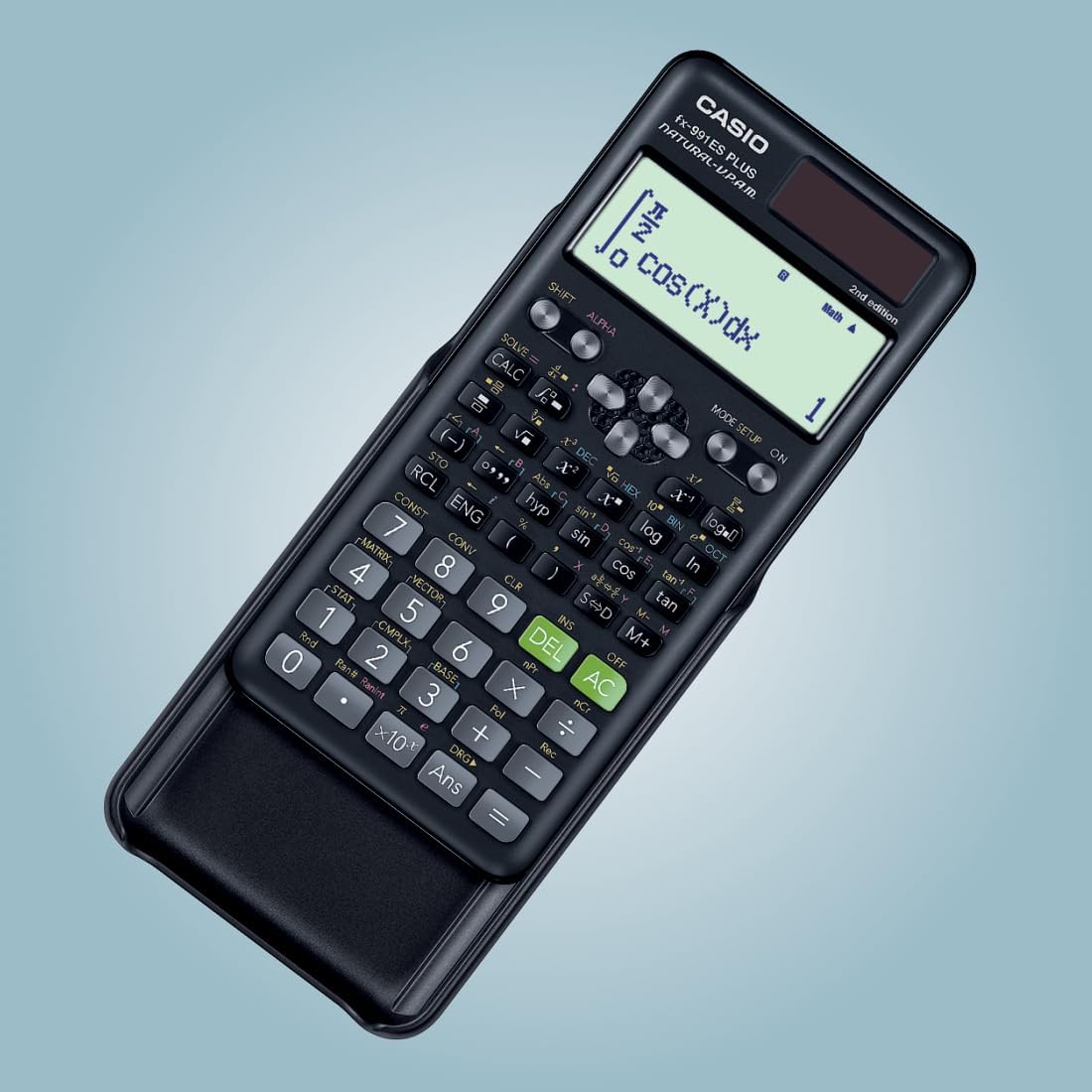
Casio FX-991ES Plus
The professional-grade scientific calculator with 417 functions, natural display, and solar power. Perfect for students and professionals.
View on Amazon