Time Unit Converter
Convert between different time units including seconds, minutes, hours, days, and more
Conversion Result
Converted to All Units
Common Time Conversions
Standard Units
- • 1 minute = 60 seconds
- • 1 hour = 60 minutes = 3,600 seconds
- • 1 day = 24 hours = 86,400 seconds
- • 1 week = 7 days = 168 hours
Calendar Units
- • 1 month ≈ 30.4375 days (avg.)
- • 1 year = 365.25 days (Julian)
- • 1 decade = 10 years
- • 1 century = 100 years
Sub-Second Units
- • 1 second = 1,000 milliseconds
- • 1 millisecond = 1,000 microseconds
- • 1 microsecond = 1,000 nanoseconds
- • 1 second = 1,000,000,000 nanoseconds
Useful Equivalences
- • 1 year ≈ 8,766 hours
- • 1 year ≈ 525,960 minutes
- • 1 year ≈ 31,557,600 seconds
- • 1 fortnight = 14 days = 1,209,600 seconds
Understanding Time Units
Time is one of the seven SI base quantities. The SI base unit of time is the second, originally defined as 1/86,400 of a mean solar day, and since 1967 defined by the cesium-133 atomic transition. Unlike most measurement systems, time uses a mixed-radix system: seconds and minutes are base-60 (inherited from ancient Babylon), while hours, days, weeks, and years follow different conventions rooted in astronomy.
Sub-Second Units
- Nanosecond (ns): 10-9 seconds. Used in computing (CPU clock cycles), electronics, and particle physics. Light travels approximately 30 cm in one nanosecond.
- Microsecond (µs): 10-6 seconds. Used in electronics, signal processing, audio engineering, and network latency measurement.
- Millisecond (ms): 10-3 seconds. Used in computing (response times), medicine (heart rate intervals), sports timing, and photography (shutter speed).
Standard Units
- Second (s): The SI base unit of time. Defined as the duration of 9,192,631,770 periods of the radiation corresponding to the transition between two hyperfine levels of the ground state of the cesium-133 atom.
- Minute (min): 60 seconds. A standard unit for everyday time measurement, cooking, sports, and scheduling.
- Hour (hr): 60 minutes or 3,600 seconds. The primary unit for measuring durations of work, travel, and daily activities.
Calendar Units
- Day (d): 24 hours or 86,400 seconds. Based on one full rotation of the Earth on its axis. The mean solar day is approximately 86,400.002 seconds and gradually increasing due to tidal deceleration.
- Week (wk): 7 days. A cultural unit with no direct astronomical basis, used universally for organizing work and rest cycles. Adopted by the Roman Empire and standardized in ISO 8601.
- Fortnight (fn): 14 days (2 weeks). Commonly used in British English and in countries like the UK, Australia, and New Zealand for pay periods and scheduling.
- Month (mo): Approximately 30.4375 days (average based on 365.25/12). Calendar months vary from 28 to 31 days. The concept originates from the lunar cycle (~29.53 days).
- Year (yr): 365.25 days (Julian year). The tropical year (time for the Sun to return to the same equinox point) is approximately 365.2422 days. The Gregorian calendar averages 365.2425 days per year.
Extended Units
- Decade: 10 years. Used in historical analysis, demographics, climate studies, and cultural references.
- Century: 100 years. Used in history, geology, and long-term planning. The 21st century began on January 1, 2001.
- Millennium: 1,000 years. Used in archaeology, geology, and long-scale historical discussion. The current millennium began on January 1, 2001.
Time in Context: How Long Things Take
Ultra-Fast
- • CPU clock cycle: ~0.3 ns
- • Camera flash: ~1 ms
- • Human blink: ~100-400 ms
- • Hummingbird wingbeat: ~20 ms
- • Lightning flash: ~0.2 s
Human Scale
- • Average heartbeat: ~0.8 s
- • 100m sprint record: ~9.58 s
- • Boil a kettle: ~3-4 min
- • Average commute: ~26 min
- • Feature film: ~2 hr
Astronomical
- • Moon orbit: ~27.3 days
- • Earth orbit (year): 365.25 days
- • Mars orbit: ~687 days
- • Jupiter orbit: ~11.86 years
- • Pluto orbit: ~248 years
A Brief History of Time Measurement
The measurement of time has evolved dramatically through human history, from observing celestial patterns to atomic precision:
Different Types of Years
The concept of a "year" varies depending on the reference frame used. This converter uses the Julian year (365.25 days), which is the standard in astronomy and the SI system.
Julian Year
Exactly 365.25 days (31,557,600 seconds). Used as the standard year in astronomy and the SI system. The basis for defining the light-year.
Tropical Year
Approximately 365.2422 days. The time for the Sun to return to the same equinox point. This is what the Gregorian calendar approximates.
Gregorian Year
Averages 365.2425 days over a 400-year cycle (97 leap years per 400 years). The calendar system used worldwide for civil purposes.
Sidereal Year
Approximately 365.2564 days. The time for the Earth to complete one orbit relative to the distant stars. About 20 minutes longer than the tropical year.
References
The conversion factors used in this calculator are based on internationally recognized standards and definitions:
Note: All conversions use exact or internationally accepted conversion factors. The second is defined by the International Bureau of Weights and Measures (BIPM) using the cesium-133 atomic transition. The year used in this converter is the Julian year (exactly 365.25 days or 31,557,600 seconds), which is the standard used in astronomy and the SI system. Calendar months are averaged as 1/12 of a Julian year (30.4375 days). Actual calendar months range from 28 to 31 days.
Related Calculators
Recommended Calculator
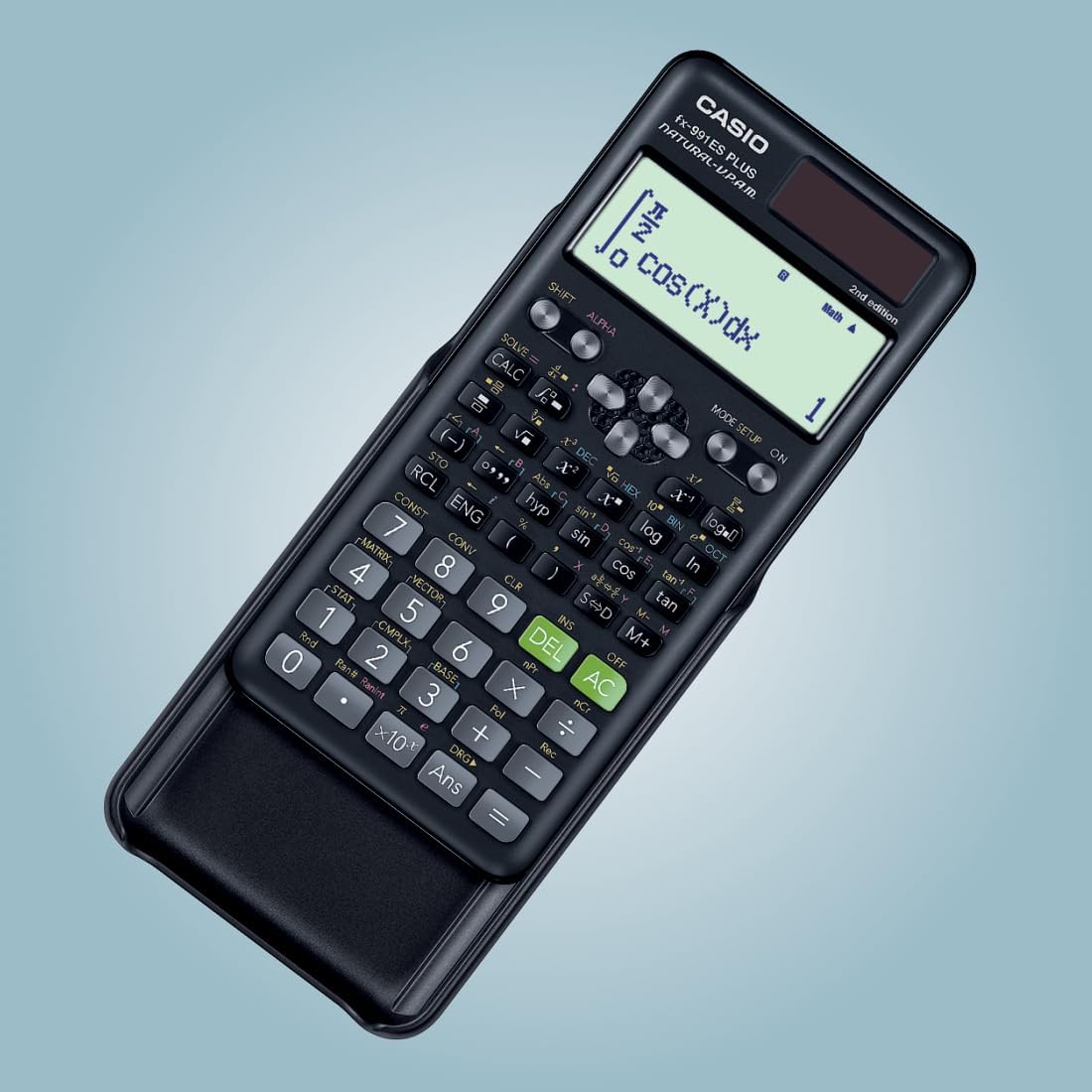
Casio FX-991ES Plus
The professional-grade scientific calculator with 417 functions, natural display, and solar power. Perfect for students and professionals.
View on Amazon