Fraction Simplifier
Simplify fractions to their lowest terms and convert between fractions, decimals, and percentages
Enter a fraction or mixed number to simplify to its lowest terms.
Original Fraction
Simplified Fraction
Mixed Number
Decimal
Percentage
Step-by-Step Solution
How to Simplify a Fraction
Simplifying (or reducing) a fraction means rewriting it so that the numerator and denominator have no common factors other than 1. The simplified fraction represents the same value but uses the smallest possible whole numbers.
- Find the Greatest Common Divisor (GCD) of the numerator and denominator.
- Divide both the numerator and denominator by the GCD.
- The resulting fraction is in its simplest form (lowest terms).
Example
Simplify 12/18
Step 1: GCD(12, 18) = 6
Step 2: 12 ÷ 6 = 2, 18 ÷ 6 = 3
Result: 12/18 = 2/3
Fraction Formulas & Methods
Euclidean Algorithm for GCD
The Euclidean algorithm is an efficient method for computing the Greatest Common Divisor of two integers. It works by repeatedly replacing the larger number with the remainder of dividing the two numbers until the remainder is zero.
GCD(a, b) = GCD(b, a mod b) when b ≠ 0
GCD(a, 0) = a
Fraction Arithmetic Rules
Addition: a/b + c/d = (ad + bc) / bd
Subtraction: a/b - c/d = (ad - bc) / bd
Multiplication: a/b × c/d = ac / bd
Division: a/b ÷ c/d = a/b × d/c = ad / bc
Conversions
Fraction → Decimal: numerator ÷ denominator
Fraction → Percentage: (numerator ÷ denominator) × 100%
Decimal → Fraction: Write over power of 10, then simplify
Mixed → Improper: (whole × den + num) / den
Improper → Mixed: whole = ⌊num/den⌋, remainder = num mod den
Key Fraction Concepts
Proper vs. Improper Fractions
A proper fraction has a numerator smaller than the denominator (e.g. 3/4). An improper fraction has a numerator greater than or equal to the denominator (e.g. 7/4). Improper fractions can be expressed as mixed numbers (e.g. 1 3/4).
Equivalent Fractions
Two fractions are equivalent if they represent the same value. For example, 2/4, 3/6, and 1/2 are all equivalent. Simplifying a fraction finds the equivalent fraction with the smallest numerator and denominator.
Common Denominator
To add or subtract fractions with different denominators, you first find a common denominator — typically the Least Common Multiple (LCM) of the two denominators. Then you rewrite each fraction with that denominator before performing the operation.
Negative Fractions
A negative sign can appear in the numerator, denominator, or in front of the fraction. All three are equivalent: -3/4 = 3/(-4) = -(3/4). By convention, the negative sign is placed with the numerator or in front of the fraction.
Common Fraction — Decimal — Percentage Equivalents
| Fraction | Decimal | Percentage |
|---|---|---|
| 1/2 | 0.5 | 50% |
| 1/3 | 0.3333... | 33.33% |
| 2/3 | 0.6666... | 66.67% |
| 1/4 | 0.25 | 25% |
| 3/4 | 0.75 | 75% |
| 1/5 | 0.2 | 20% |
| 1/6 | 0.1666... | 16.67% |
| 1/8 | 0.125 | 12.5% |
| 3/8 | 0.375 | 37.5% |
| 7/8 | 0.875 | 87.5% |
References
The formulas and methods used in this calculator are based on established mathematical principles from authoritative sources:
Related Calculators
This calculator provides mathematically exact results for integer fractions. When converting decimals to fractions, results are approximated to a reasonable precision. Always verify calculations when using results for academic or professional purposes.
Recommended Calculator
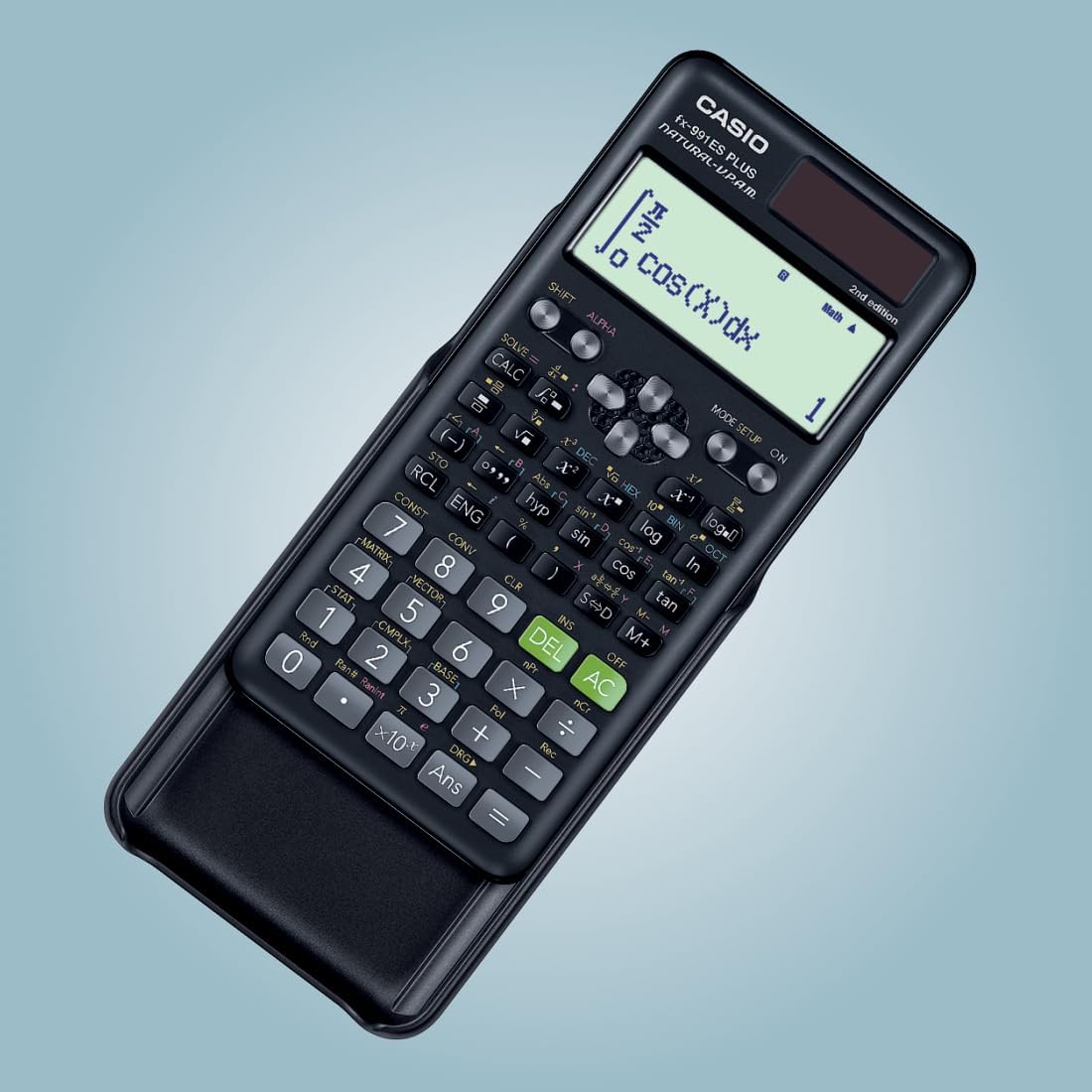
Casio FX-991ES Plus
The professional-grade scientific calculator with 417 functions, natural display, and solar power. Perfect for students and professionals.
View on Amazon