Linear Equation Solver
Solve single linear equations or systems of 2 and 3 linear equations with step-by-step solutions.
Enter coefficients for: ax + b = c
Enter coefficients for the system:
4x − 1y = 2
Enter coefficients for the system:
3x − 1y + 2z = 1
2x + 1y + 3z = 7
Solution
Step-by-Step Solution
Understanding Linear Equations
A linear equation is an algebraic equation in which each term is either a constant or the product of a constant and a single variable raised to the first power. Linear equations form straight lines when graphed on a coordinate plane.
Single Linear Equation
Form: ax + b = c
A single linear equation in one variable always has exactly one solution (when a ≠ 0). The solution is found by isolating x: x = (c − b) / a.
System of Two Equations (2×2)
Form: a₁x + b₁y = c₁ and a₂x + b₂y = c₂
A system of two linear equations in two unknowns can have one unique solution (intersecting lines), no solution (parallel lines), or infinitely many solutions (identical lines). This calculator uses Cramer's Rule and the elimination method to find the solution.
System of Three Equations (3×3)
Form: a₁x + b₁y + c₁z = d₁, a₂x + b₂y + c₂z = d₂, a₃x + b₃y + c₃z = d₃
A system of three linear equations in three unknowns represents three planes in 3D space. The solution is the point where all three planes intersect. This calculator uses Cramer's Rule with 3×3 determinants.
Solution Methods
Cramer's Rule
Uses determinants of the coefficient matrix to solve for each variable. For a 2×2 system:
- D = a₁b₂ − a₂b₁
- x = (c₁b₂ − c₂b₁) / D
- y = (a₁c₂ − a₂c₁) / D
Elimination Method
Systematically eliminates variables by adding/subtracting equations:
- 1. Multiply equations to match coefficients
- 2. Add/subtract to eliminate a variable
- 3. Solve the resulting equation
- 4. Back-substitute to find remaining variables
Substitution Method
Solves for one variable in terms of others:
- 1. Isolate one variable in one equation
- 2. Substitute into the other equation(s)
- 3. Solve the simplified equation
- 4. Back-substitute to find all variables
Matrix Method
Represents the system as Ax = b and solves using the inverse:
- 1. Write the augmented matrix [A|b]
- 2. Perform row reduction (Gaussian elimination)
- 3. Achieve row echelon form
- 4. Read solutions from reduced matrix
Common Examples
Example 1: Single Equation
Solve: 3x + 5 = 14
Step 1: Subtract 5 from both sides: 3x = 9
Step 2: Divide both sides by 3: x = 3
Example 2: 2×2 System
Solve: 2x + y = 5 and x − y = 1
Step 1: Add both equations: 3x = 6, so x = 2
Step 2: Substitute x = 2 into equation 1: 2(2) + y = 5,
so y = 1
Solution: x = 2, y = 1
Example 3: 3×3 System
Solve: x + y + z = 6, 2x − y + z = 3, x + 2y − z = 3
Solution: x = 1, y = 2, z = 3
References
The methods and formulas used in this calculator are based on well-established linear algebra and algebraic principles:
Related Calculators
This calculator provides solutions to linear equations using standard algebraic methods. Results are for educational and informational purposes. While we strive for accuracy, please verify important calculations independently.
Recommended Calculator
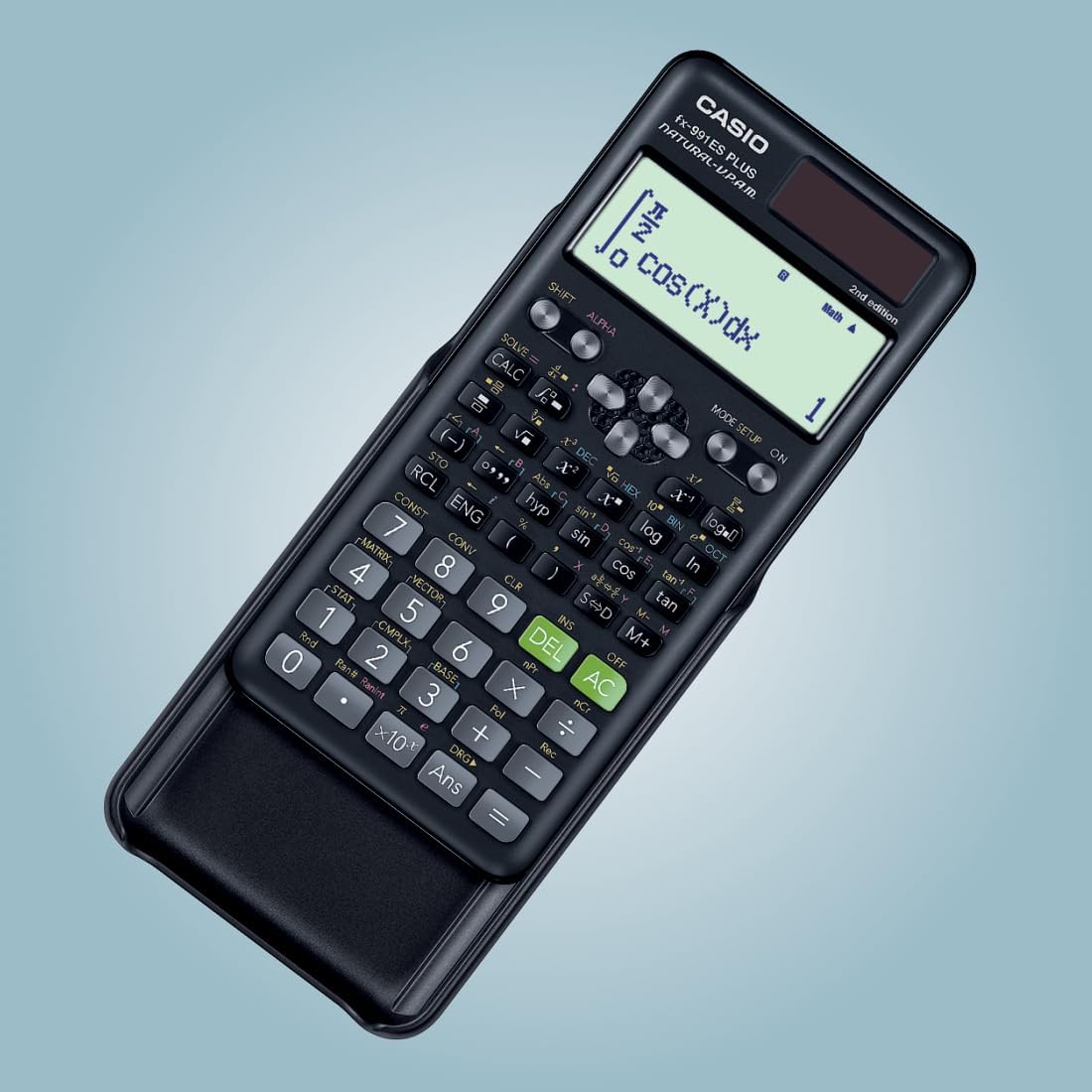
Casio FX-991ES Plus
The professional-grade scientific calculator with 417 functions, natural display, and solar power. Perfect for students and professionals.
View on Amazon