Probability Calculator
Calculate probabilities for events, combinations, permutations, and conditional probability
If unknown, leave blank and provide P(B|not A) below
Results
Step-by-Step Solution
Probability Formulas
Probability is a branch of mathematics that quantifies the likelihood of events occurring. Values range from 0 (impossible) to 1 (certain). The following are the core formulas used in probability theory.
Basic Probability
- P(A) = favorable outcomes / total outcomes
- P(not A) = 1 - P(A) — Complement rule
Multiple Events
- P(A ∪ B) = P(A) + P(B) - P(A ∩ B) — Addition rule (union)
- P(A ∩ B) = P(A) × P(B) — If A and B are independent
- P(A ∩ B) = 0 — If A and B are mutually exclusive
Conditional Probability & Bayes' Theorem
- P(A|B) = P(A ∩ B) / P(B) — Conditional probability
- P(A|B) = P(B|A) × P(A) / P(B) — Bayes' theorem
- P(B) = P(B|A)P(A) + P(B|¬A)P(¬A) — Law of total probability
Counting Methods
- n! = n × (n-1) × ... × 1 — Factorial
- nCr = n! / [r!(n-r)!] — Combinations (order doesn't matter)
- nPr = n! / (n-r)! — Permutations (order matters)
Types of Probability Events
Independent Events
Two events are independent if the occurrence of one does not affect the probability of the other.
- • Flipping a coin twice
- • Rolling two separate dice
- • P(A ∩ B) = P(A) × P(B)
Mutually Exclusive Events
Two events are mutually exclusive if they cannot both occur at the same time.
- • Rolling a 3 or a 5 on one die
- • Drawing a heart or a spade from one card
- • P(A ∩ B) = 0
Dependent Events
The outcome of the first event affects the probability of the second event.
- • Drawing cards without replacement
- • Selecting items from a bag without returning them
- • P(A ∩ B) = P(A) × P(B|A)
Complementary Events
The complement of an event A consists of all outcomes not in A. The two always sum to 1.
- • Getting heads vs. not getting heads
- • Raining vs. not raining
- • P(A) + P(not A) = 1
Common Probability Examples
| Experiment | Event | Probability |
|---|---|---|
| Coin flip | Getting heads | 1/2 = 0.5 |
| Single die roll | Rolling a 6 | 1/6 ≈ 0.1667 |
| Single die roll | Rolling even number | 3/6 = 0.5 |
| Deck of cards | Drawing an ace | 4/52 ≈ 0.0769 |
| Deck of cards | Drawing a heart | 13/52 = 0.25 |
| Two dice | Sum equals 7 | 6/36 ≈ 0.1667 |
| Two coin flips | Both heads | 1/4 = 0.25 |
References
The formulas and concepts used in this calculator are based on established probability theory from the following sources:
- Weisstein, Eric W. "Probability." MathWorld — A Wolfram Web Resource
- Weisstein, Eric W. "Bayes' Theorem." MathWorld — A Wolfram Web Resource
- Khan Academy — Probability
- Wikipedia — Probability
- Wikipedia — Bayes' Theorem
- Introduction to Probability, Statistics, and Random Processes (Pishro-Nik, UMass Amherst)
Related Calculators
This calculator provides mathematical probability calculations based on standard formulas from probability theory. Results are accurate to six decimal places. While we strive for accuracy, please verify critical calculations independently. Note that n values above 170 may exceed JavaScript's floating-point precision for factorials. This tool is for educational and informational purposes.
Recommended Calculator
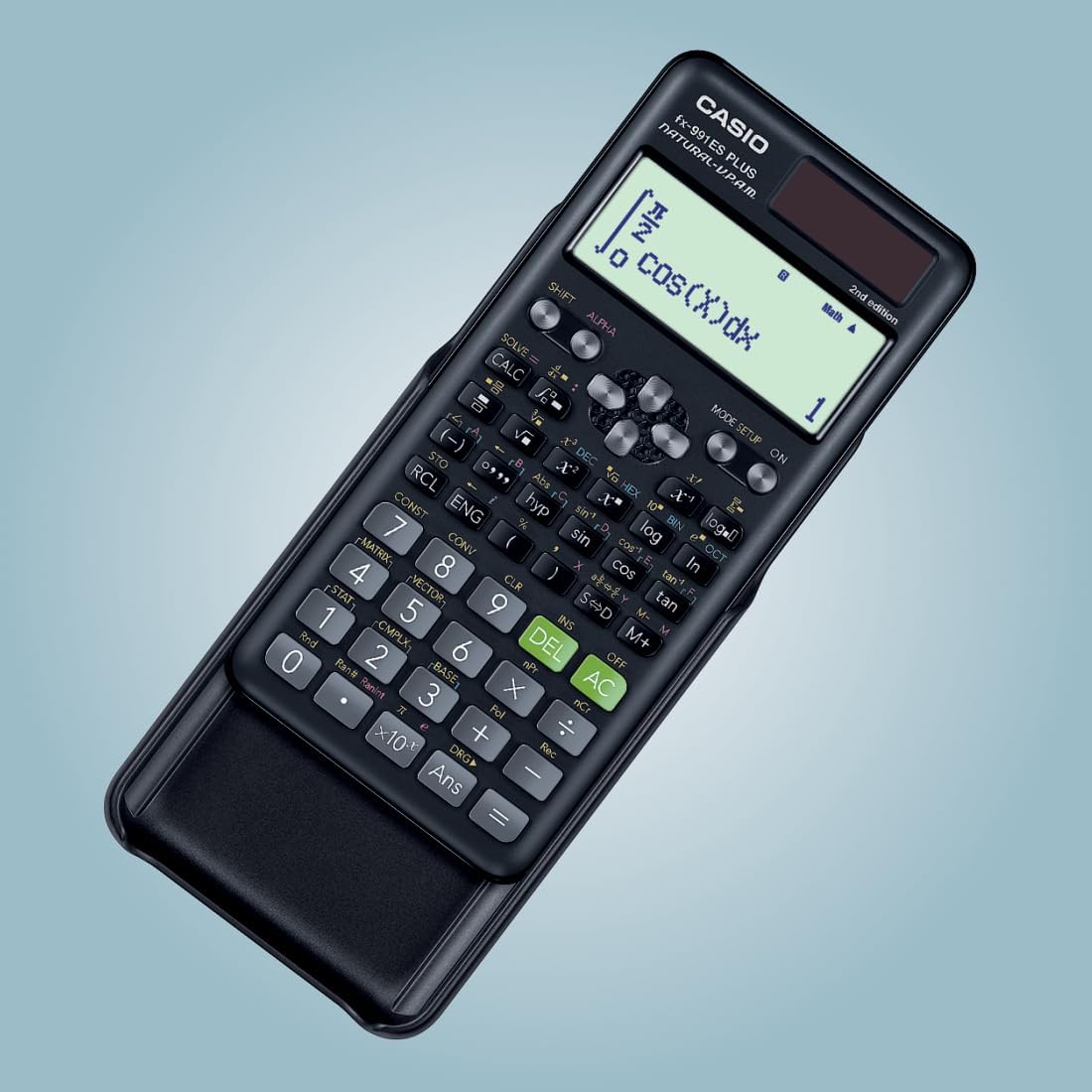
Casio FX-991ES Plus
The professional-grade scientific calculator with 417 functions, natural display, and solar power. Perfect for students and professionals.
View on Amazon