Force Calculator
Calculate force, mass, and acceleration using Newton's second law of motion
Force (F)
Mass (m)
Acceleration (a)
Calculation Details
Newton's Laws of Motion
Force is a fundamental concept in classical mechanics. Newton's second law of motion states that the net force acting on an object is equal to the product of its mass and acceleration. This relationship, expressed as F = ma, is one of the most important equations in physics and forms the foundation of dynamics.
Newton's Three Laws
- First Law (Inertia): An object at rest stays at rest, and an object in motion stays in motion at constant velocity, unless acted upon by a net external force.
- Second Law (F = ma): The acceleration of an object is directly proportional to the net force acting on it and inversely proportional to its mass.
- Third Law (Action-Reaction): For every action, there is an equal and opposite reaction.
Key Formulas
- F = ma — Net force equals mass times acceleration
- W = mg — Weight equals mass times gravitational acceleration
- f = μN — Friction force equals coefficient of friction times normal force
- F_net = ΣF — Net force is the vector sum of all forces
Common Types of Forces
Gravitational Force (Weight)
- • Formula: W = mg
- • Always directed toward Earth's center
- • g ≈ 9.807 m/s² on Earth's surface
- • Varies with altitude and planetary body
Normal Force
- • Perpendicular to the contact surface
- • Prevents objects from passing through surfaces
- • Equal to weight on flat horizontal surfaces
- • Changes on inclined planes
Friction Force
- • Formula: f = μN
- • Opposes relative motion or tendency of motion
- • Static friction ≥ Kinetic friction
- • Depends on surface materials
Tension Force
- • Transmitted through strings, ropes, or cables
- • Pulls equally on both ends
- • Always directed along the length of the connector
- • Ideal ropes have uniform tension throughout
Real-World Examples
Understanding force is essential in engineering, sports science, and everyday life. Here are some practical applications:
- A 1,500 kg car accelerating at 3 m/s² requires a net force of 4,500 N
- An 80 kg person weighs about 784 N on Earth but only 130 N on the Moon
- A 0.145 kg baseball pitched at 40 m/s and stopped in 0.01 s experiences about 580 N of force
- The friction force on a 50 kg box (μ = 0.4) on a flat surface is approximately 196 N
References
The formulas and physical constants used in this calculator are based on established physics principles and verified sources:
Related Calculators
Note: This calculator assumes ideal conditions with constant forces and does not account for relativistic effects, air resistance, or variable mass systems. Results are based on classical Newtonian mechanics and may differ from real-world scenarios involving very high speeds or microscopic scales.
Recommended Calculator
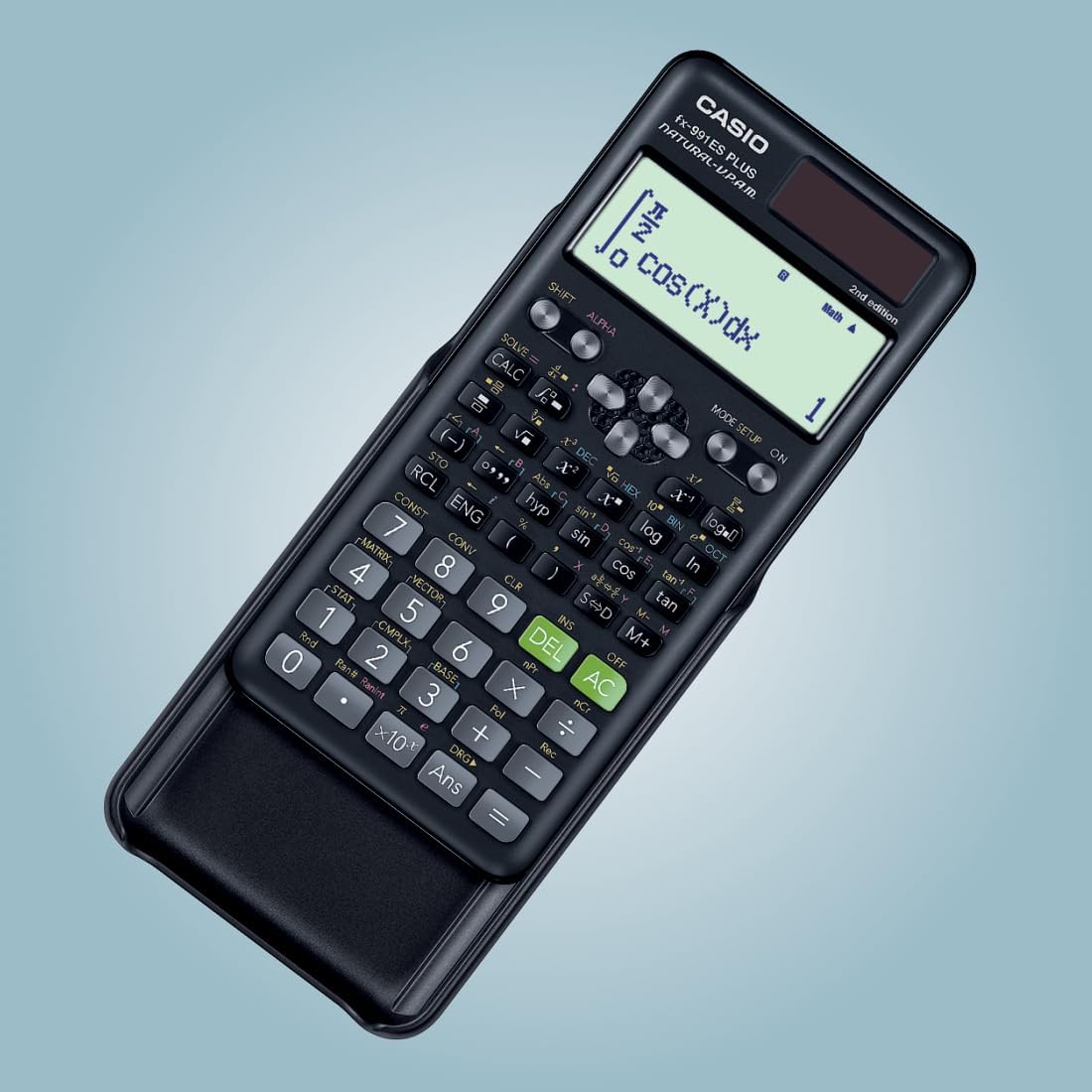
Casio FX-991ES Plus
The professional-grade scientific calculator with 417 functions, natural display, and solar power. Perfect for students and professionals.
View on Amazon