Orbital Period Calculator
Calculate orbital period, semi-major axis, and central body mass using Kepler's third law
Orbital Period (T)
Semi-Major Axis (a)
Central Body Mass (M)
Orbital Velocity (v)
Orbital Circumference
Gravitational Parameter (μ)
About Kepler's Third Law
Kepler's third law of planetary motion states that the square of the orbital period of a planet is directly proportional to the cube of the semi-major axis of its orbit. Combined with Newton's law of universal gravitation, this allows us to calculate orbital parameters for any body orbiting a central mass.
Key Equations
- T² = (4π² / GM) × a³ — Kepler's third law (Newton's form)
- T = 2π √(a³ / GM) — Orbital period from semi-major axis and mass
- a = ∛(GM T² / 4π²) — Semi-major axis from period and mass
- M = 4π² a³ / (G T²) — Central body mass from period and semi-major axis
- v = 2πa / T — Mean orbital velocity (circular approximation)
Variables
- T — Orbital period (s)
- a — Semi-major axis (m)
- M — Mass of the central body (kg)
- G — Gravitational constant (6.674 × 10⁻¹¹ N·m²/kg²)
- v — Mean orbital velocity (m/s)
- μ = GM — Standard gravitational parameter (m³/s²)
Kepler's Three Laws of Planetary Motion
First Law — Law of Ellipses
Every planet moves in an elliptical orbit with the Sun at one of the two foci. The semi-major axis (a) is half the longest diameter of the ellipse and defines the size of the orbit.
Second Law — Law of Equal Areas
A line joining a planet and the Sun sweeps out equal areas during equal intervals of time. This means a planet moves faster when it is closer to the Sun (at perihelion) and slower when farther away (at aphelion).
Third Law — Law of Harmonies
The square of the orbital period of a planet is proportional to the cube of the semi-major axis of its orbit (T² ∝ a³). This is the law used by this calculator to relate period, orbital size, and central body mass.
Solar System Orbital Data
The table below shows the orbital parameters of the eight planets in our Solar System, demonstrating how Kepler's third law applies across vastly different scales.
| Planet | Semi-Major Axis (AU) | Orbital Period (years) | Orbital Velocity (km/s) | Eccentricity |
|---|---|---|---|---|
| Mercury | 0.387 | 0.241 | 47.4 | 0.206 |
| Venus | 0.723 | 0.615 | 35.0 | 0.007 |
| Earth | 1.000 | 1.000 | 29.8 | 0.017 |
| Mars | 1.524 | 1.881 | 24.1 | 0.093 |
| Jupiter | 5.203 | 11.862 | 13.1 | 0.049 |
| Saturn | 9.537 | 29.457 | 9.7 | 0.057 |
| Uranus | 19.191 | 84.011 | 6.8 | 0.046 |
| Neptune | 30.069 | 164.790 | 5.4 | 0.011 |
Notable Orbits Around Earth
Low Earth Orbit (LEO)
- • Altitude: 160–2,000 km
- • Period: ~90 min – 2 hours
- • Velocity: ~7.8 km/s
- • ISS, Hubble, Starlink
Geostationary Orbit (GEO)
- • Altitude: ~35,786 km
- • Period: ~23 h 56 min (1 sidereal day)
- • Velocity: ~3.1 km/s
- • Weather & communication satellites
Lunar Orbit
- • Distance: ~384,400 km
- • Period: ~27.3 days (sidereal)
- • Velocity: ~1.0 km/s
- • Earth's natural satellite
References
The physical constants and planetary data used in this calculator are based on established scientific sources:
Related Calculators
Note: This calculator assumes two-body Keplerian orbits and uses the mean orbital velocity approximation for circular orbits. Real orbits are influenced by perturbations from other bodies, relativistic effects, and orbital eccentricity. Planetary data is based on NASA Goddard Planetary Fact Sheets. Gravitational constant G = 6.674 × 10⁻¹¹ N·m²/kg² (NIST CODATA).
Recommended Calculator
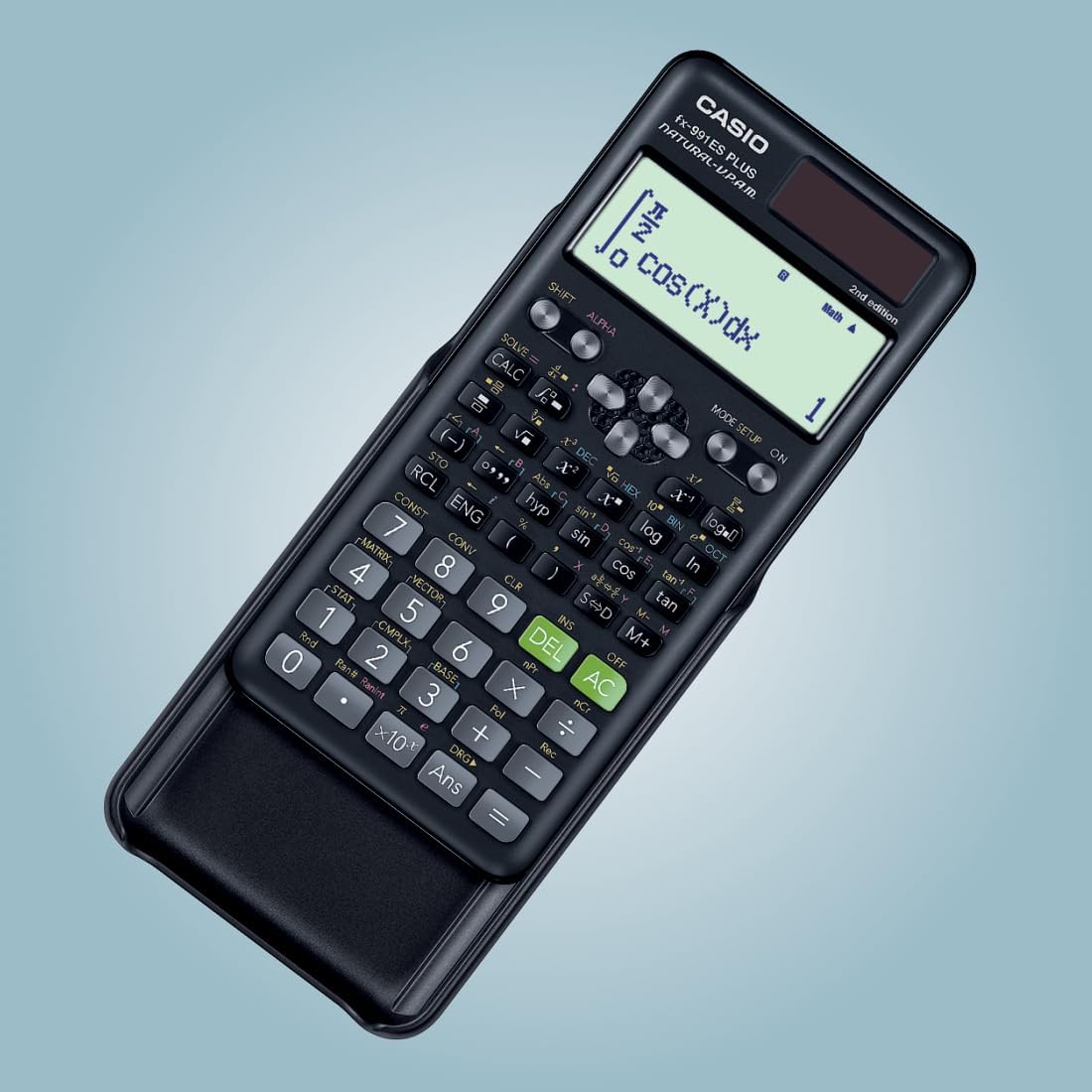
Casio FX-991ES Plus
The professional-grade scientific calculator with 417 functions, natural display, and solar power. Perfect for students and professionals.
View on Amazon