Moving Average Calculator
Calculate simple, weighted, and exponential moving averages to smooth time series data, identify trends, and filter out short-term noise.
Enter numeric values separated by commas, spaces, or newlines.
Data Points
Window Period
MA Values
Latest MA
Visualization
Results Table
| Period | Value | Moving Avg | Deviation |
|---|
Moving Average Formulas
Simple Moving Average (SMA)
The unweighted mean of the previous n data points. Each point in the window has equal influence on the result.
Weighted Moving Average (WMA)
Assigns linearly increasing weights to more recent observations. The most recent data point receives weight n, the second-most-recent receives n−1, and so on.
Exponential Moving Average (EMA)
Where α = 2 / (n + 1) by default. Applies exponentially decreasing weights to older observations. The first EMA value is typically set to the SMA of the first n data points.
What Is a Moving Average?
A moving average is a statistical calculation used to analyze data points by creating a series of averages from different subsets of the full data set. It is one of the most widely used tools in time series analysis, commonly applied in finance, economics, signal processing, and quality control. Moving averages help smooth out short-term fluctuations and highlight longer-term trends or cycles in the data.
Key Uses
- Trend identification: Reveals the underlying direction of data by filtering out random noise and short-term volatility.
- Data smoothing: Reduces the impact of outliers and irregular fluctuations for cleaner visual analysis.
- Forecasting: Serves as a simple baseline for predicting future values based on recent patterns.
- Signal detection: Crossovers between fast and slow moving averages can signal changes in momentum or trend direction.
Comparing Moving Average Types
SMA
- • Equal weight to all points in window
- • Most lag of the three types
- • Best for stable, low-noise data
- • Simplest to compute and interpret
- • Widely used in quality control
WMA
- • Linear weights favor recent data
- • Less lag than SMA
- • Good balance of smoothing and responsiveness
- • Finite window like SMA
- • Common in technical analysis
EMA
- • Exponentially decreasing weights
- • Least lag — most responsive
- • Never fully discards old data
- • Adjustable sensitivity via α
- • Popular in stock market analysis
Practical Examples
- Stock market: Traders use 50-day and 200-day SMAs to identify long-term trends. A "golden cross" (50-day crossing above 200-day) signals bullish momentum; a "death cross" signals bearish momentum.
- Sales forecasting: Retailers apply a 4-week moving average to weekly sales to smooth seasonal fluctuations and predict inventory needs.
- Manufacturing: Quality engineers use moving averages on production measurements to detect process drift before defects occur.
- Epidemiology: Public health agencies report 7-day moving averages of daily case counts to smooth reporting irregularities (e.g., weekend dips) and reveal true infection trends.
- Signal processing: Engineers apply moving averages as low-pass filters to remove high-frequency noise from sensor data.
Choosing the Right Window Size
The window period (n) controls the trade-off between smoothness and responsiveness:
Smaller Window (e.g., 3–5)
More responsive to recent changes but retains more noise. Best when you need to detect rapid shifts or when the data has a strong, fast-changing trend.
Larger Window (e.g., 20–50+)
Smoother output with less noise but more lag. Best for identifying long-term trends in highly volatile data or when short-term fluctuations are not meaningful.
References
The formulas and methods used in this calculator are based on established statistical and time series analysis theory:
Related Calculators
Note: This calculator implements standard moving average formulas for educational and analytical purposes. The EMA is initialized using the SMA of the first n data points. Results are rounded to the selected decimal precision but computed at full floating-point accuracy. For critical financial or engineering decisions, verify results with professional statistical or trading software.
Recommended Calculator
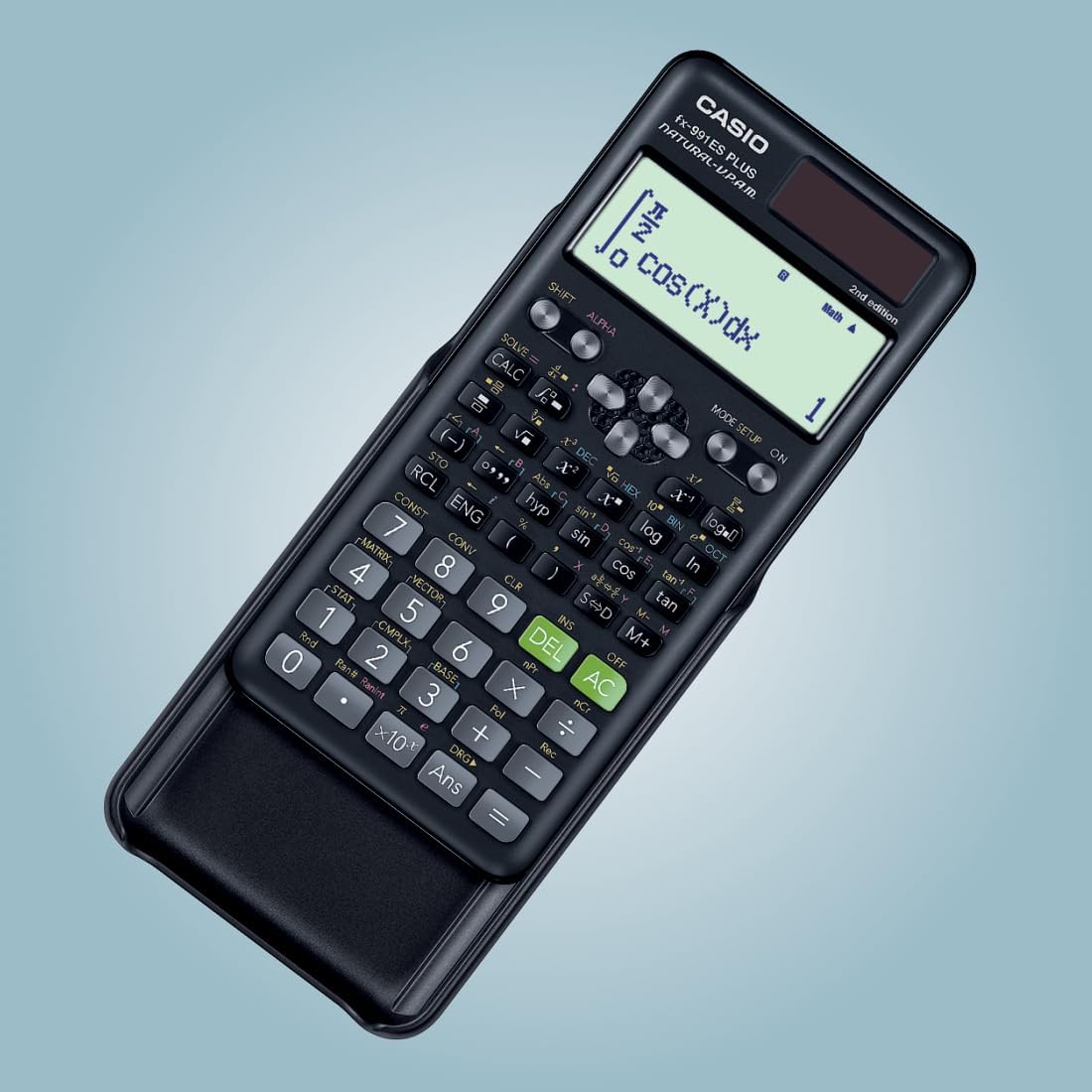
Casio FX-991ES Plus
The professional-grade scientific calculator with 417 functions, natural display, and solar power. Perfect for students and professionals.
View on Amazon