Sample Size Calculator
Determine the required sample size for surveys and experiments based on your desired confidence level, margin of error, and population characteristics.
Use 0.5 if unknown (gives the largest sample size).
Estimated standard deviation of the population.
Desired margin of error in the same units as the mean.
Leave blank if the population is very large or unknown.
Required Sample Size
Infinite Population Sample Size
Z-Score Used
Finite Population Correction
Calculation Breakdown
Sample Size by Confidence Level & Margin of Error
| Margin of Error | 90% CL | 95% CL | 99% CL |
|---|
Sample Size Formulas
For Estimating a Proportion
For Estimating a Mean
Finite Population Correction
Where:
- n = required sample size (before finite population correction)
- Z = z-score corresponding to the desired confidence level
- p = estimated population proportion (use 0.5 if unknown)
- E = desired margin of error (as a decimal for proportions, absolute for means)
- σ = population standard deviation (for mean estimation)
- N = total population size (for finite population correction)
- nadj = adjusted sample size after finite population correction
Understanding Sample Size Determination
Sample size determination is one of the most important steps in designing a survey or experiment. Choosing a sample that is too small may produce results that lack statistical power, while an unnecessarily large sample wastes time and resources. The goal is to find the minimum number of observations needed to achieve a desired level of precision.
Key Factors That Affect Sample Size
- Confidence level: A higher confidence level (e.g., 99% vs 95%) means you need a larger sample to be more certain your interval captures the true value.
- Margin of error: A smaller margin of error requires a larger sample size to achieve greater precision.
- Population variability: Greater variability (higher standard deviation or proportion closer to 0.5) requires a larger sample.
- Population size: For small populations, the finite population correction factor reduces the required sample size. For very large populations, the population size has negligible effect.
When to Use Each Mode
Estimate a Proportion
Use this when your survey question has a yes/no or categorical answer:
- "What percentage of customers prefer product A?"
- "What fraction of voters support the proposal?"
- "What is the defect rate in our manufacturing process?"
Estimate a Mean
Use this when your measurement is a continuous numeric value:
- "What is the average customer satisfaction score?"
- "What is the mean weight of packages shipped?"
- "What is the average response time for our service?"
Common Z-Scores for Confidence Levels
| Confidence Level | α (Alpha) | Z-Score (Zα/2) |
|---|---|---|
| 80% | 0.20 | 1.2816 |
| 85% | 0.15 | 1.4395 |
| 90% | 0.10 | 1.6449 |
| 95% | 0.05 | 1.9600 |
| 99% | 0.01 | 2.5758 |
References
The formulas and methodology used in this calculator are based on standard statistical sampling theory:
- NIST/SEMATECH e-Handbook of Statistical Methods — Sample Sizes
- Wolfram MathWorld — Sample Size
- Wikipedia — Sample Size Determination
- Cochran, W. G. (1977). Sampling Techniques (3rd ed.). John Wiley & Sons. — The classic reference for sample size formulas including the finite population correction.
- Israel, G. D. (1992). "Determining Sample Size." University of Florida IFAS Extension, PEOD6. — A widely cited practical guide for survey sample size determination.
Related Calculators
Note: This calculator provides theoretical minimum sample sizes based on statistical formulas. In practice, you may need to increase your sample size to account for expected non-response rates, stratified sampling designs, or clustering effects. Always consult a statistician for complex study designs.
Recommended Calculator
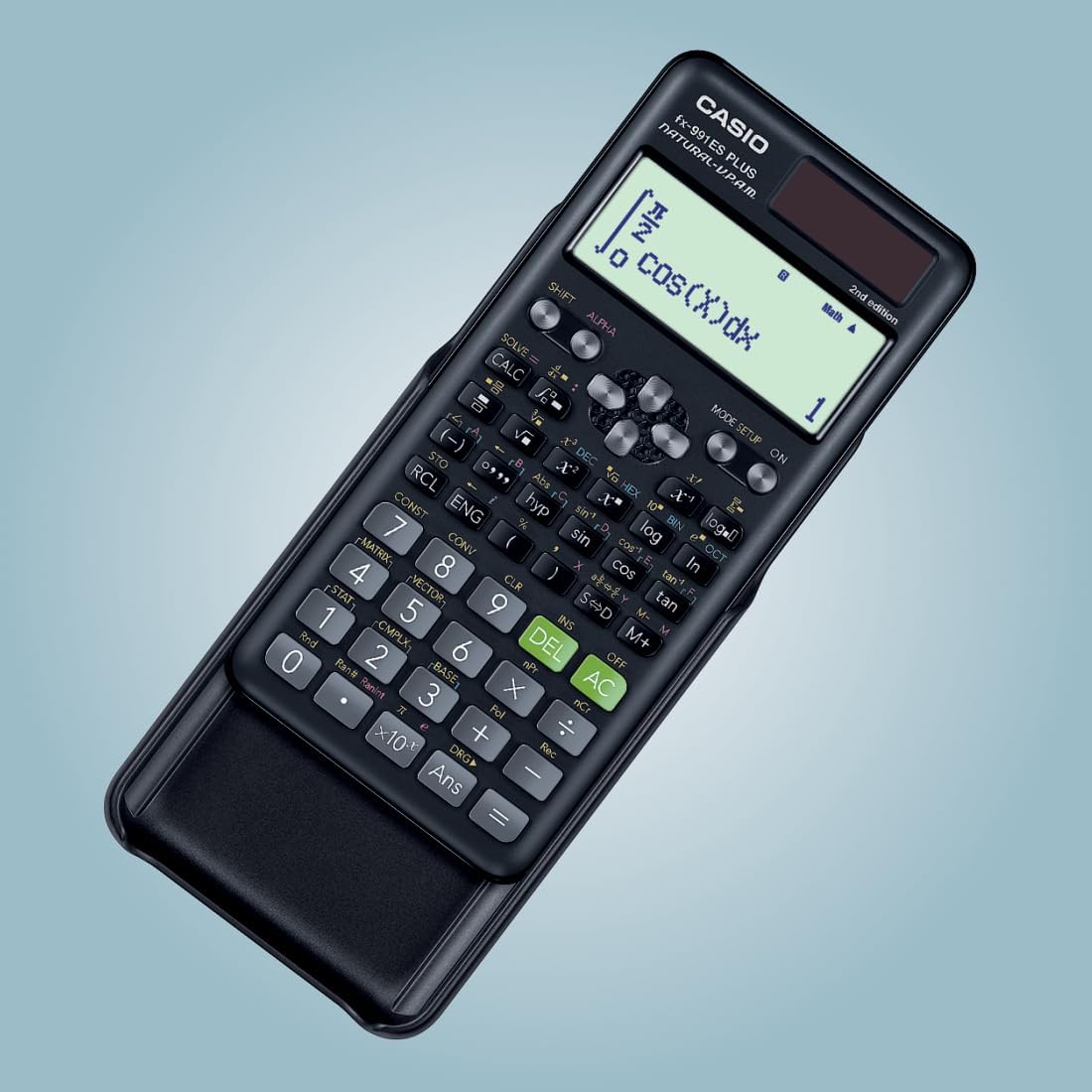
Casio FX-991ES Plus
The professional-grade scientific calculator with 417 functions, natural display, and solar power. Perfect for students and professionals.
View on Amazon